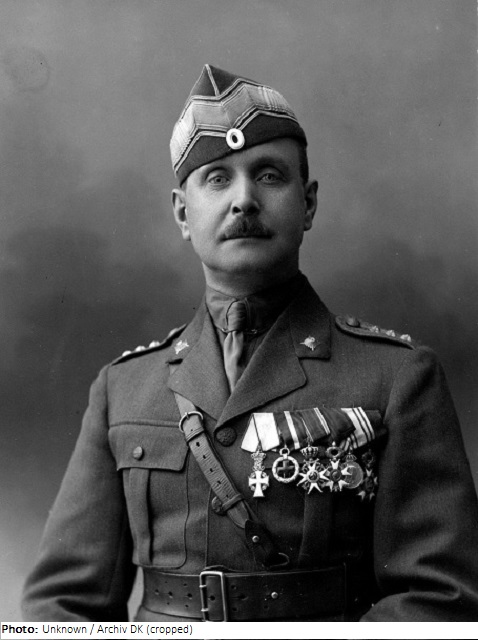
| Roles | Competed in Olympic Games |
|---|---|
| Sex | Male |
| Full name | Theodor Cizeck•von Zeilau |
| Used name | Theodor•von Zeilau |
| Born | 1 February 1884 in Nyborg, Syddanmark (DEN) |
| Died | 5 May 1970 (aged 86 years 3 months 4 days) in Fredericia, Syddanmark (DEN) |
| NOC |  Denmark Denmark |
Theodor von Zeilau’s father was a Danish career officer of Bohemian descent. When he was 14-years-old his family moved from Nyborg to København (Copenhagen). Like his father and older brother, he was also to become a career officer. Von Zeilau attended the Army’s officer school at Frederiksborg Castle from 1902-04 and became first lieutenant in the 21st Battalion. Educated at Hellerup, he completed both military and civilian gymnastics training and then became deputy head of the Army’s gymnastics school.
Von Zeilau competed in the first edition of modern pentathlon in Stockholm in 1912 but did not finish the fourth discipline, the riding. One year after the Games he was sent to the Danish West Indies as commander of the gendarmerie corps and fort commander on the island of Saint Croix, which is now part of the U.S. Virgin Islands. In 1916 he was ordered home because he was accused of abuse of his power with his service pistol during a farm workers’ uprising. Back in Denmark, he was tried by a court-martial but acquitted.
In 1917, von Zeilau was appointed commander of a prisoner-of-war camp at Hald, where the Red Cross had a hospital camp for sick and injured German and Austro-Hungarian prisoners of war from Russian captivity. After the end of World War I he was responsible for the repatriation of English and French prisoners of war in Berlin. Subsequently, he became an attaché in Oslo and then went to Metz in France to take part in a training course in a French mountain infantry battalion.
During the Spanish Civil War he was a military observer in the Pyrenees on the French-Spanish border from 1937-39. He then joined the 7th Regiment in Fredericia as a company commander and subsequently the King’s Jutland Infantry Regiment. He retired in 1944 during the time of German occupation. When the Danish police were interned in September 1944, von Zeilau became commander of a municipal guard to maintain order in the city. After the liberation, he helped disarm the members of the HIPO Corps, the Danish auxiliary police corps of the German troops.
In 1946, von Zeilau was sent to Hamburg as the commander of a group of German-speaking Danish soldiers who were to assist the British in censoring German letters and was given the rank of major. In this capacity, he became the first to hoist the Danish flag, the Dannebrog, in Germany after the occupation. One year later, he was sent to Germany again as barracks commander in Aurich, where part of the Danish brigade was located. During this time, he was honoured with the “Danish Red Cross Memorial Medal for War Aid Work 1939-45”.
Von Zeilau eventually retired – against his will – and settled in Fredericia, where he continued to serve in the Home Guard. He always wore his uniform, and it was rumoured that he mostly lived on military field rations. Like his brother, he never married. He was also never a nobleman but added the “von” to his name to comply with the German custom. Among his orders and decorations were the Knight’s Cross of the 1st Class of the Order of St. Olav, the Knight’s Cross of the Belgian Crown Order, the Knight’s Cross of the Legion of Honour, the Knight of the Dannebrog, and the King’s Order of Merit.
| Games | Discipline (Sport) / Event | NOC / Team | Pos | Medal | As | |
|---|---|---|---|---|---|---|
| 1912 Summer Olympics | Modern Pentathlon | DEN |
Theodor von Zeilau | |||
| Individual, Men (Olympic) |