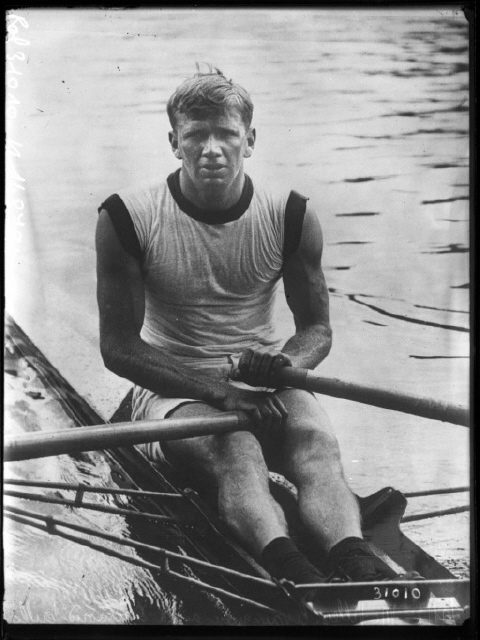
| Roles | Competed in Olympic Games |
|---|---|
| Sex | Male |
| Full name | Cecil Leventhorpe•McVilly |
| Used name | Cecil•McVilly |
| Born | 20 August 1890 in Hobart, Tasmania (AUS) |
| Died | 4 November 1964 (aged 74 years 2 months 15 days) in Cowes, Victoria (AUS) |
| Affiliations | Derwent Rowing Club, Hobart (AUS) |
| NOC |  Australasia Australasia |
| Nationality |  Australia Australia |
Cecil McVilly was an Australian national. He started his rowing career at the Queen’s College in Hobart. As a sculler he competed successfully at regattas in Tasmania placing second at the Tasmanian championship in 1909 and third at the Hobart Regatta in 1910. Representing Tasmania, he won the championship in the single sculls at the Interstate Regattas in 1910, 1911 and 1914.
McVilly travelled to Europe with the Australasian team in 1912 competing in the Diamond Challenge Sculls at Henley and subsequently at the Stockholm Olympics. There, he collided with the German Martin Stahnke in his heat and was disqualified for interference. McVilly stayed in Europe and trained with the London Rowing Club. In 1913 he took part in his second Diamond Sculls this time winning the challenge race while representing the Derwent Rowing Club from Hobart. After his return to Australia McVilly not only won his third Interstate title but also coached the Tasmanian eight to claim their first Interstate Championship.
Before World War I he worked as a commercial traveller and in 1915 married Kathleen Agnes Williams. The couple had two twin daughters.
In World War I McVilly first served in a Tasmanian reserve battalion. In 1916 he was promoted to the rank of a lieutenant in the Australian Imperial Force (AIF) and transferred to England to undergo military training. In November that year his 40th Battalion was stationed at the Western Front in France. As a captain he saw action in the Battle of Messines in June 1917 and was awarded the Military Cross for his leadership. In the Third Battle of Ypres in October he was heavily wounded. In 1918, McVilly was deployed to Mesopotamia and was later involved in the defence of Baku at the Caspian Sea. Demobilised in 1919, he returned to his homeland.
There, he continued his service in the reserve of the Australian Military Forces. McVilly worked in Tasmania’s Repatriation Commission from 1919. Ten years later, he was appointed Inspector of Charities in Victoria and in 1948, he became Chairman of the Victorian Hospitals and Charities Commission.
In 1921, McVilly had a comeback as a rower as a member of the Tasmanian eight who placed second in the King’s Cup of that year’s Interstate Regatta. He then took up coaching again and led the Tasmanian eight in the King’s Cup to a second place in 1925 and to victory in 1926. Later, he was appointed secretary of the Tasmanian Rowing Association and Australia’s selector for the 1928 Olympic Games in Amsterdam.
After retiring he settled in Cowes in Victoria. In 2015, Rowing Australia introduced the McVilly-Pearce Pin, named after him and Bobby Pearce, Australia’s first Olympic Gold medallist in rowing. It is awarded to every Australian rower who represents Australia at high level international regattas.
| Games | Discipline (Sport) / Event | NOC / Team | Pos | Medal | Nationality | As | |
|---|---|---|---|---|---|---|---|
| 1912 Summer Olympics | Rowing | ANZ |
AUS |
Cecil McVilly | |||
| Single Sculls, Men (Olympic) | AC h2 r1/4 |