| Roles | Competed in Olympic Games |
|---|---|
| Sex | Male |
| Full name | Aleksandr Pavlovich•Rodzyanko |
| Used name | Aleksandr•Rodzyanko |
| Original name | Александр Павлович•Родзянко |
| Born | 26 August 1879 |
| Died | 6 May 1970 (aged 90 years 8 months 11 days) in New York, New York (USA) |
| NOC |  Russian Federation Russian Federation |
Aleksandr Rodzyanko was a descendant from a noble family of Ukrainian Cossacks. He completed his education at the Page Corps in 1899 and graduated from the Cavalry Officers’ School in 1907. In the following year, Rodzyanko attended the Cavalry School in Saumur in France. He served in the Cavalry Guards Regiment and was successively promoted to lieutenant (1903), staff captain (1907), captain (1911) and colonel (1912). During this period, he commanded cavalry squadrons and was head of the regimental training team for one year. Beginning in 1912, he was an assistant for logistics of the regiment’s commander.
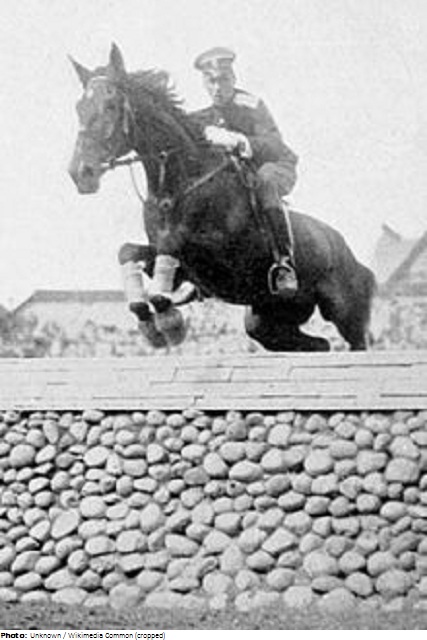
Rodzyanko began competing in international equestrian events as early as 1902. For his achievements at the tournament in Turin, he was awarded the Knight’s Cross of the Italian Order of the Crown. From there, he brought a new technique of riding, developed by the Italian captain Federico Caprilli, to Russia, where it spread quickly. In 1911, Rodzyanko was a member of the Russian team at the tournament in London celebrating the coronation of King George V. In 1912, he represented Russia in show jumping at the Stockholm Olympics. With his horse Eros he placed 16th in the individual and fifth in the team event. Rodzyanko’ brother Pavel, trained at the Italian Cavalry School under Caprilli to become one of the top 10 equestrians in the world.
After short spells with Cossack regiments, Rodzyanko served in the 2nd Caucasian Regiment in World War I. In 1915, he was appointed staff officer in the Cavalry Guards Regiment and one year later, regimental commander of the Cavalry Officers’ School. In 1917, he was successively commander of the 1st Brigade of the 17th Cavalry Division, of the Riga garrison and the 17th Cavalry Division. In the last year of the war, he was taken prisoner in Pskov, which was occupied by German troops, and subsequently interned in Germany. Rodzyanko was awarded various degrees of the Orders of St. Vladimir, St. Stanislav and St. Anne.
Later in 1918, Rodzyanko returned to Rīga and formed an anti-Bolshevik battalion in Pskov. In the Civil War, he rose to commander of the Northern Corps of the Whites and led some successful attacks against the Red Army in the border area between Estonia and Russia. In October 1919, he was promoted to lieutenant general and became an assistant of the commander of the Northwestern Army. Rodzyanko was involved in the offensive on Petrograd (St. Petersburg) and the capture of the Tsar’s residence of Tsarskoye Selo.
After the defeat of the Whites, Rodzyanko was sent to England to seek support to restore the Northwestern Army. When his mission failed, he went first to Stockholm and later to Germany. In 1921, he published his memoirs in Berlin. Eventually, he emigrated to the United States, where he was active as chairman of organisations of emigrees of Tsarist veterans.
| Games | Discipline (Sport) / Event | NOC / Team | Pos | Medal | As | |
|---|---|---|---|---|---|---|
| 1912 Summer Olympics | Equestrian Jumping (Equestrian) | RUS |
Aleksandr Rodzyanko | |||
| Individual, Open (Olympic) | Eros | =16 | ||||
| Team, Open (Olympic) | Eros / Russia | 5 |