| Roles | Competed in Olympic Games |
|---|---|
| Sex | Male |
| Full name | Lev Ivanovich•Favorsky |
| Used name | Lev•Favorsky |
| Original name | Лев Иванович•Фаворский |
| Born | 1893 in Moskva (Moscow), Moskva (RUS) |
| Died | 1969 in Moskva (Moscow), Moskva (RUS) |
| Measurements | 174 cm / 72 kg |
| Affiliations | SKS, Moskva (RUS) |
| NOC |  Russian Federation Russian Federation |
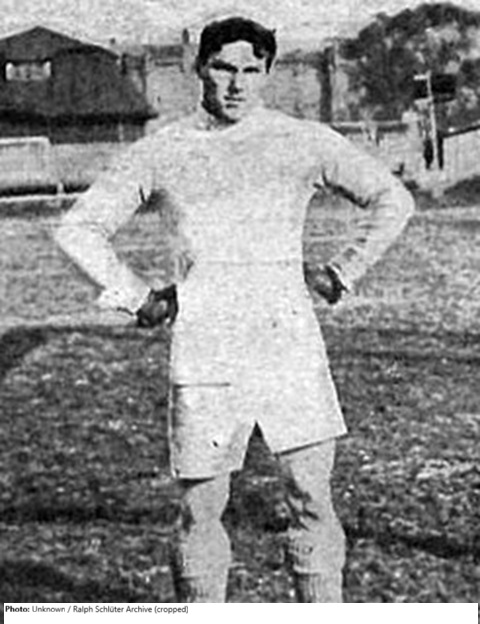
While attending school in Moskva, Lev Favorsky joined the Three Stars team as a goalkeeper in 1908. He had an early début, when the club’s regular goalkeeper was arrested for political reasons. After a short stint with the club Bratovshchina, he played for SKS from 1910-12. Together with other former SKS players, Favorsky founded Pushkino Club. In 1911 and 1912, he was a member of the team representing the Moskva region in various national and international matches.
In May 1912, Favorsky took part in a qualifier between Moskva and St. Petersburg, which ended in a 2-2 draw after a tumultuous match. He was then appointed as starting goalkeeper of the Russian team at the 1912 Olympics. Favorsky played his first official match for the national team during the Olympic football tournament against Finland, which they lost 2-1. Discord between the Moscow and St. Petersburg players and officials flared up again. Subsequently, they lost 16-0 against Germany in the consolation round, not the least due to a poor performance by Favorsky.
In 1912, he played two more games with the national team against Norway and Hungary. During the latter, Favorsky sustained a serious knee injury, which eventually ended his international career. In his four matches for the national team, he conceded 29 goals. He is considered one of the first Russian goalkeepers trying to catch balls coming to the goal rather than to parry them. However, when opposing players were shooting low into the corner, he frequently missed the ball.
In 1913, he transferred to the Pushkin Sports Circle, and in 1914, to the Bykovo Club. He also coached the Bykovo Club’s children’s team. However, after sustaining the knee injury in late 1912, he unable to play at his highest level any longer.
Favorsky later graduated from the Natural Sciences Department of the Physics and Mathematics Faculty of Moscow University. A doctor of Chemical Sciences and a professor of Inorganic Chemistry, he taught in the Chemistry Department of the All-Union Industrial Academy of Light Industry and the Moscow Polygraphic Institute. In 1924, he filed a patent for a method for producing clay pigeons used as moving targets in shooting, which was granted in the following year. He continued to live in Moskva. In 1942, he was briefly arrested on a false denunciation, leading to his relatives being evicted from Moscow. His younger brother, Nikolai, later became deputy chairman of the State Bank of the USSR.
| Games | Discipline (Sport) / Event | NOC / Team | Pos | Medal | As | |
|---|---|---|---|---|---|---|
| 1912 Summer Olympics | Football (Football) | RUS |
Lev Favorsky | |||
| Football, Men (Olympic) | Russia | =5 |