| Roles | Competed in Olympic Games |
|---|---|
| Sex | Male |
| Full name | Pavel Borisovich•Valden |
| Used name | Pavel•Valden |
| Original name | Павел Борисович•Вальден |
| Born | 3 August 1887 in Ulyanovsk, Ulyanovsk (RUS) |
| Died | 28 September 1948 (aged 61 years 1 month 25 days) in Moskva (Moscow), Moskva (RUS) |
| NOC |  Russian Federation Russian Federation |
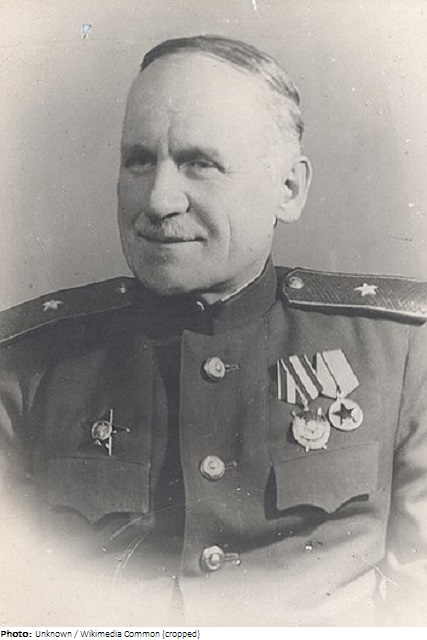
Pavel Valden was a member of the nobility and the son of a career officer. He was educated in the Nizhny Novgorod Count Arakcheev Cadet Corps and received military training from the Pavlovsk Military School in St. Petersburg. After graduating in 1907 he was assigned to the Life Guards 2nd Rifle Battalion, before later being deployed in the Life Guards 2nd Tsarskoye Selo Rifle Regiment. Valden was appointed lieutenant in 1911.
He participated in the 1912 Olympic Games in five military and free rifle events. Two years later, he won gold at the second All-Russian Olympics in 300 metres military rifle shooting, and won silver in the 300 metres military rifle shooting at two targets.
Valden took part in World War I where he was shell-shocked in 1914. He was wounded in his left thigh, which resulted in his leg being amputated and replaced by a wooden prothesis. He continued to serve in the Life Guards and was promoted eventually to the rank of colonel in 1917. Subsequently, he was appointed Commander of the 2nd Guards Rifle Reserve Regiment. During the Kerensky-Krasnov uprising in October 1917 Valden was elected chief of staff of the revolutionary troops in the Pulkovo region, leading them into the battle on the Pulkovo Heights against General Krasnov’s troops. Later, the People’s Commissar for Military and Naval Affairs in the Bolshevik government, Leon Trotsky, appointed him again as commander of his former regiment until the demobilization. In the Russian Imperial Army, he was awarded the orders of St. Stanislaus, St. Anna, and St. Vladimir.
From April 1918 Valden served in the Red Army as instructor of shooting in various positions. Later, he was commander-director of the Leningrad Armoured Courses for Advanced Training and Retraining of Commanders as well as teacher at the Military-Technical Academy of the Red Army. From 1934 he was a senior lecturer at the Military Academy of Mechanization and Motorization of the Red Army. In 1944 he was promoted to major general of the Tank Forces. In 1948 he was forced to retire due to illness. In the Red Army during World War II, he was awarded the Order of Lenin, the Order of the Red Banner, and the Order of the Red Star, along with various other distinctions.
| Games | Discipline (Sport) / Event | NOC / Team | Pos | Medal | As | |
|---|---|---|---|---|---|---|
| 1912 Summer Olympics | Shooting | RUS |
Pavel Valden | |||
| Free Rifle, Men (Olympic) | 62 | |||||
| Free Rifle, Team, Men (Olympic) | Russia | 7 | ||||
| Military Rifle, Three Positions, Men (Olympic) | 11 | |||||
| Military Rifle, Men (Olympic) | 45 | |||||
| Military Rifle, Team, Men (Olympic) | Russia | 9 |
Name previously given as Pavel de Valdayne, but this is bastardization of his name.