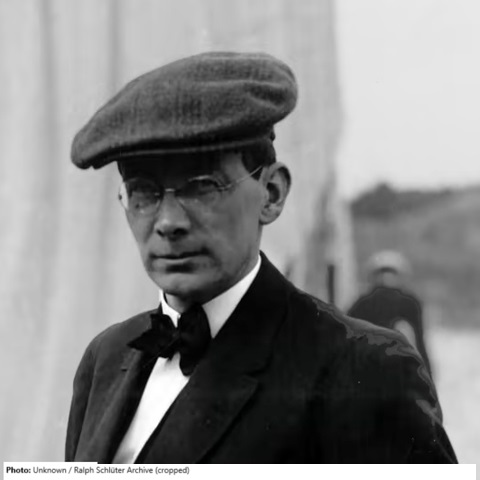
| Roles | Competed in Olympic Games |
|---|---|
| Sex | Male |
| Full name | Axel Gustaf•Estlander |
| Used name | Gustaf•Estlander |
| Born | 18 September 1876 in Helsinki, Uusimaa (FIN) |
| Died | 1 December 1930 (aged 54 years 2 months 13 days) in Stockholm, Stockholm (SWE) |
| Measurements | 176 cm / 82 kg |
| NOC |  Finland Finland |
Gustaf Estlander was the skipper of the Finnish yacht “Örn”. Although the boat placed third in both races of the 8 metres class at the Stockholm Olympics they missed the bronze medal race, ranking fourth on accumulated points. He competed in yacht racing for 30 years and in over 1,500 races winning, amongst others, the Sinebrychoff Trophy in sailing in 1914 with the boat “Irene”.
Estlander was considered one of the leading boat designers in Finland and Sweden, respectively. He became particularly known as the designer of R-boats and archipelago cruisers, which are sought-after classics today. A total of 700 to 800 yachts were built based on his designs. In 1901, he became chief designer at the Hammars yacht yard near Porvoo. In 1919, he designed the 150 sqm archipelago cruiser “Singoalla”, which was considered the fastest sailing boat in the Baltic Sea until it burned down in a shipyard fire. 1921-23 he was chief designer and owner of the Pabst shipyard in Berlin-Köpenick. In the mid-1920, he moved to Sweden and acquired Swedish citizenship to be eligible for designing a Swedish entries for the Scandinavian Gold Cup. His creation “May Be” won the Gold Cup in the USA in 1927 followed by “Ingegerd” and “Ian” in 1929 and 1930.
Gustaf Estlander owned boats all over Europe including boats by other designers to familiarize himself with their characteristics. Among the best known boats designed by him are 8mR-class yacht “Sphinx” (1928) and the 6mR-class “Ian” (1929), the latter of which he sailed himself quite successfully. His 8mR design “Sheerio” represented Finland at the 1936 Olympic Games and reached 5th place.
Before the turn of the century, Estlander was an avid speed skater. At the 1898 European Championships in Helsinki, he won all events and the allround championship. He finished second in 1897 and 1899 at the Europeans. In 1898, he also claimed the Finnish allround championship and placed second in 1897. In 1897, he also clocked the first ever Finnish record over 500 metres on domestic tracks, setting national records in all other events in the following year. In 1898, he also held all official Finnish speed skating records on international tracks
The Estlanders were a noble Finnish family which is now extinct. Gustaf’s father was the professor of surgery Jakob August Estlander (1831–1881). Gustaf married Hildur Ingrid Qvarnström in 1901 and divorced in 1922. They had one son and two daughters. In 1925, he re-married Ingrid Maria Lindeberg. His brother Ernst Estlander was also a sailing Olympian in the 6 metres class in 1912.
Gustaf Estlander graduated from a private Swedish school in Helsinki in 1894 and as an architect from the Polytechnic Institute in 1898. He founded the architectural firm Estlander & Settergren and designed several large residential buildings in the national romantic style in Helsinki from 1903 to 1915. Today, many are classified as culturally and historically valuable. Among his well-known designs are the Nyländska Jaktklubben pavilion from 1898 and the Tusculum building in the Etu-Töölö neighbourhood from 1911. From 1914, he focused on yacht design.
| Games | Discipline (Sport) / Event | NOC / Team | Pos | Medal | As | |
|---|---|---|---|---|---|---|
| 1912 Summer Olympics | Sailing | FIN |
Gustaf Estlander | |||
| 8 metres, Open (Olympic) | Örn | 4 |