| Roles | Competed in Olympic Games • Non-starter |
|---|---|
| Sex | Male |
| Full name | Giulio•Sarrocchi |
| Used name | Giulio•Sarrocchi |
| Born | 24 May 1887 in Roma, Roma (ITA) |
| Died | 18 July 1971 (aged 84 years 1 month 25 days) in Roma, Roma (ITA) |
| Affiliations | C. S. Audace, Roma (ITA) |
| NOC |  Italy Italy |
| Medals | OG |
| Gold | 1 |
| Silver | 1 |
| Bronze | 0 |
| Total | 2 |
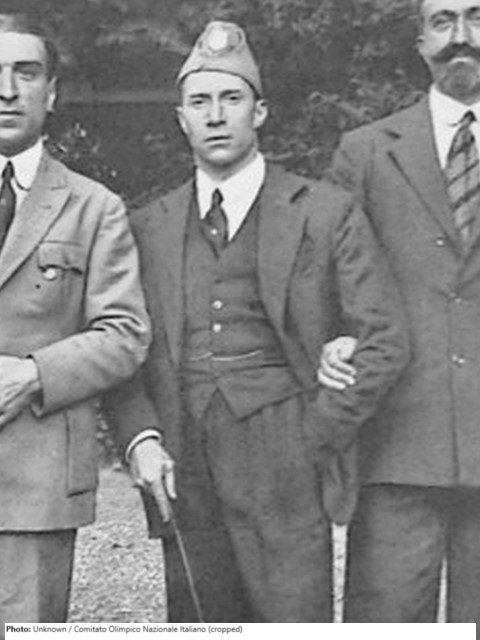
Giulio Sarrocchi started as a track and field athlete in the 100 m and the high jump. He also competed in football, swimming, boxing, cycling, wrestling, and even weightlifting, winning the Central-Southern Italy Championship in 1919. Before World War II, he was already a successful fencer selected for the individual sabre event but eventually he did not start. Trained by a professional fencing master, he focused on the sabre as his preferred weapon.
Sarrocchi’s top level career began in 1921, when he came second in the sabre at the Italian championship beaten by Oreste Puliti just like in 1922. At the 1922 European Championships he placed fifth. Although hindered by a sprained knee – suffered while trying to stop a runaway horse in Roma – he placed second at the national championships for a third time in a row, again behind Puliti.
After winning the “Pontenani Cup”, Sarrocchi tried to qualify for the Paris Olympics in 1924 in all three weapons but eventually only qualified in the trials with the sabre. In Paris, he competed in the sabre team event. He was deployed in the matches against Czechoslovakia in round one, against the USA and Belgium in the quarter-final and against Argentina in the semi-final. In the final round, Sarrocchi did well only against Czechoslovakia, winning three of four bouts, but lost all four bouts against the Netherlands and won just one against Hungary, Italy’s strongest opponents. When the tied match against Hungary was decided on touches Italy won gold in the team event.
The individual tournament started on the following day and Sarrocchi eventually reached the final, where the Italians were drawn against each other initially and Puliti defeated his three countrymen easily, including Sarrocchi. But the Hungarian judge György Kovács, ruled that the Italians had thrown their matches to Puliti to allow him a better chance to win gold. Puliti was incensed and threatened to cane Kovács, which caused the Jury to disqualify Puliti. The other three Italians then withdrew in protest, and the final proceeded without the four Italians.
In 1925, Sarrocchi finally won the Italian sabre title, the first of three in a row in spite of fierce competition within the Italian team. He also won the “Pontenani Cup” in 1925 and 1926. After claiming his third national championship in 1927, he prepared for the 1928 Olympic Games in Amsterdam. While skipping the 1928 Italian Championships, he won the final trial to secure his place in the team for Amsterdam already at the age of 40. In the sabre team event, Sarrocchi fenced against Greece in round one and against the Netherlands in the semi-final. In the final, without Sarrocchi, Italy lost to Hungary but he was on the floor again when Italy won against Germany to secure silver.
After that, his career was drawing to a close and he only competed occasionally and with minor success. The city of Roma has named a path in the Villa Carpegna park after him.
| Games | Discipline (Sport) / Event | NOC / Team | Pos | Medal | As | |
|---|---|---|---|---|---|---|
| 1912 Summer Olympics | Fencing | ITA |
Giulio Sarrocchi | |||
| Sabre, Individual, Men (Olympic) | ||||||
| 1924 Summer Olympics | Fencing | ITA |
Giulio Sarrocchi | |||
| Sabre, Individual, Men (Olympic) | DNS final | |||||
| Sabre, Team, Men (Olympic) | Italy | 1 | Gold | |||
| 1928 Summer Olympics | Fencing | ITA |
Giulio Sarrocchi | |||
| Sabre, Team, Men (Olympic) | Italy | 2 | Silver |