| Roles | Competed in Olympic Games |
|---|---|
| Sex | Male |
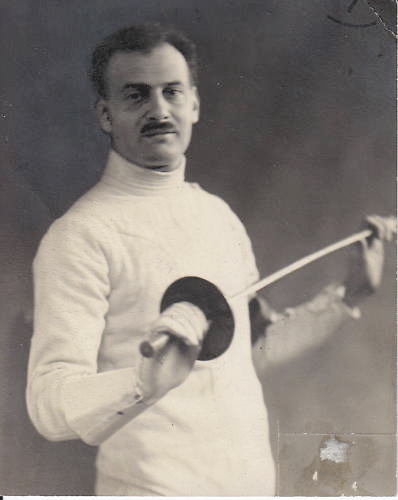
| Full name | Jacques Martin•Ochs |
| Used name | Jacques•Ochs |
| Born | 18 February 1883 in Nice, Alpes-Maritimes (FRA) |
| Died | 3 April 1971 (aged 88 years 1 month 13 days) in Liège, Liège (BEL) |
| Affiliations | Salle Thirifay, Liège (BEL) |
| NOC |  Belgium Belgium |
| Medals | OG |
| Gold | 1 |
| Silver | 0 |
| Bronze | 0 |
| Total | 1 |
Jacques Ochs was the son of Jewish musicians from Frankfurt am Main in Germany. When he was 10-years-old the family moved to Liège and Jacques started to attend drawing classes at the local Academy of Fine Arts four years later. From 1899-1903 he was a full-fledged student at the academy. Until 1906, he then spent some time in Tuscany and completed his training in Paris. In 1905, Ochs obtained Belgian nationality.
During his studies, he practised various sports including rowing, wrestling, and swimming until his friend and fellow painter Henri Anspach took him to the fencing hall in 1907. Over the next decade, Ochs became a three-time Belgian épée champion and won the 1914 World Championship with the épée. At the 1912 Stockholm he competed in the individual foil and épée events and was a member of the Belgian gold winning épée team. He took part in the 1919 Inter-Allied Games, although a plane crash in 1917 left him disabled and eventually ended his athletic career.
In 1910, Ochs decided to focus on caricature and joined the satirical weekly Pourquoi Pas? His sketches appeared on numerous editions until 1958 and made him famous. Additionally, he continued to paint genre, historical, and scenes from everyday life, increasingly turning to portraits, and exhibit his works. A volunteer in World War I, he served in the artillery and later in the Air Force, where he was shot down and seriously injured.
Ochs was appointed professor of painting at the Academy of Fine Arts in Liège in 1921. From 1934-48 he acted as the academy’s director. In his concurrent position as curator of the Museum of Fine Arts in Liège he acquired many paintings that were considered by the Nazis to be Degenerate Art.
After the occupation by German troops in World War II, he joined the resistance movement but was arrested in 1940 by the German secret police Gestapo after being denounced as Jewish. Ochs was interned at Fort Breendonk, where he produced a series of charcoal drawings of convicts and executioners. He was released two years later thanks to the then German governor of Belgium, who was later involved in the failed attempt to assassinate Hitler. In July 1944, Ochs was arrested again, together with his sister, due to an old anti-Hitler caricature published in Pourquoi Pas? He was eventually sentenced to death but was saved and freed during the liberation of Belgium in September 1944.
After World War II, Ochs worked again as a cartoonist, notably again for Pourquoi Pas?, and participated in the 1945 Walloon National Congress. In 1965, eye problems forced him to give up drawing and painting completely. His many distinctions included in Belgium the Grand Officer of the Order of Leopold Grand Officer of the Order of Leopold, the War Cross 1914-1918 with six palms, the Political Prisoner’s Cross with three stars Gold Medal for Sports Merit, in France the Officer of the Legion of Honour, the Medal of the French Resistance, the Gold Medal of Arts, Sciences, and Letters and the War Cross 1914-1918.
| Games | Discipline (Sport) / Event | NOC / Team | Pos | Medal | As | |
|---|---|---|---|---|---|---|
| 1912 Summer Olympics | Fencing | BEL |
Jacques Ochs | |||
| Foil, Individual, Men (Olympic) | =4 p8 r2/4 | |||||
| Épée, Individual, Men (Olympic) | =4 p3 r2/4 | |||||
| Épée, Team, Men (Olympic) | Belgium | 1 | Gold | |||
| Sabre, Individual, Men (Olympic) | ||||||
| Sabre, Team, Men (Olympic) | Belgium |