| Roles | Competed in Olympic Games |
|---|---|
| Sex | Male |
| Full name | Vladimir Vladimirovich•Andreyev |
| Used name | Vladimir•Andreyev |
| Original name | Владимир Владимирович•Андреев |
| Born | 6 October 1878 in Voronezh, Voronezh (RUS) |
| Died | 16 April 1940 (aged 61 years 6 months 10 days) in Shipka, Stara Zagora (BUL) |
| Affiliations | Varshavskogo voyennogo fekhtoval'no-gimnasticheskogo zala, Warszawa (POL) |
| NOC |  Russian Federation Russian Federation |
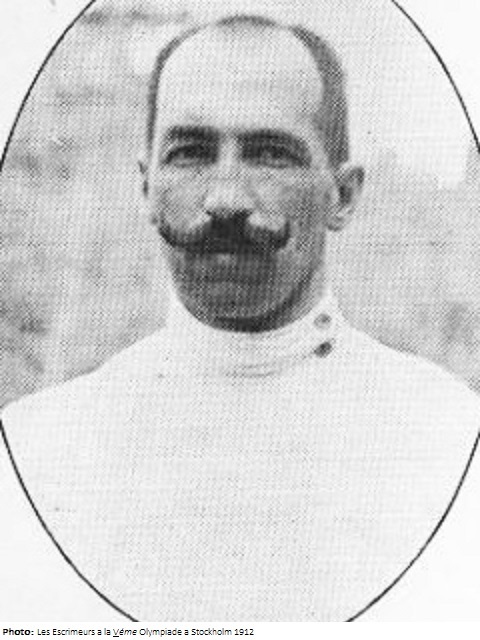
A member of the nobility, Vladimir Andreyev joined the Mikhailovsky Voronezh Cadet Corps in 1896 and attended the Pavlovsk Military School. One year later, he was promoted to non-commissioned officer. During his time at the military school, he excelled as a fencer and marksman. In 1898, he left the school to become a second lieutenant in the 184th Warsaw Reserve Infantry Regiment. Before the end of the year, he was already transferred to the Life Guards Volynsky Regiment and in 1902, he was promoted to the rank of lieutenant.
During this period, Andreyev competed successfully with the sabre in tournaments held at the Warsaw Military Fencing and Gymnastics Hall. In 1904, he was appointed as an officer in charge of the Warsaw Military Fencing and Gymnastics Hall and, later that year, promoted to staff captain. In the following years, he continued to take part in military fencing tournaments in the Russian Empire and abroad, winning first prize with foil and sabre. In 1910, he was sent to the Italian Central Fencing School in Rome for 3.5 months for further training. Subsequently, Andreyev was appointed commander of the 5th Company and promoted to the rank of captain.
At the 1912 Olympic Games in Stockholm, he competed in both sabre events. Individually, he qualified for the semi-final but did not compete there for unknown reasons. It is also unknown why he was awarded a diploma of merit together with the fencers, who placed fourth to eighth. In 1913, Andreyev took part in the First Russian Olympics in Kyiv and won a first prize in a military rifle shooting event.
In World War I, Andreyev was involved in operations against Germany and Austria-Hungary but was shell-shocked near the Vistula River after a few months. After his recovery, he was Chief of Staff of the 90th and later 80th State Militia Brigade. He later fought for the Whites in the Don Army in the Civil War and eventually emigrated to Bulgaria. There, he worked for 20 years (1920-40) as a fencing instructor at the military academy in Sofia, writing one of the first Bulgarian fencing manuals. Andreyev was instrumental in introducing fencing to Bulgaria and in founding the Bulgarian Fencing Federation. For a number of years, he coached the Bulgarian national team, including the country’s first fencing Olympian Dimitar Vasilev. He became a member of the Olympic Committee and of the National Sports Federation in Bulgaria. Already suffering from a serious illness, he died in a home for disabled soldiers.
Andreyev was married to Varvara Mitrofanovna Sinitsyna, with whom he had one daughter. He was awarded the Orders of St. Stanislav and St. Anna in Russia and the Belgian Order of the Military Cross.
| Games | Discipline (Sport) / Event | NOC / Team | Pos | Medal | As | |
|---|---|---|---|---|---|---|
| 1912 Summer Olympics | Fencing | RUS |
Vladimir Andreyev | |||
| Sabre, Individual, Men (Olympic) | DNS p2 r3/4 | |||||
| Sabre, Team, Men (Olympic) | Russia | =9 |